Sunday, April 27, 2014
Conclusions
The final chapter ties some knots about the future of the string theory. This emphasizes the never ending search for knowledge that we humans are guilty of. The fact that we need to work with string theory on its own and not let it be tested within the confines of time a gravity, to which it is currently held to. The fact that fact that through studying the theory we can breath life back in quantum mechanics. The theory of course can be tested by use of the large Hadron Collider. Perhaps through test we can fully unravel the mystery of the strings to its flu potential. This is said as string theory is like anything else, it can be fully explained.

Breaking Space
Fabric is easy to tear. You can rip a shirt, you can rip a bed sheet. Can you rip the fabric of space however? The early 1990's was a time of great breakthrough in this subject. 1992 we find Greene and two colleagues of his Aspinwell and Morrison at what was then Institute for Advance Study. There they worked on wether or not you could "flop" Calabi-Yau spaces. This more or less meant tearing the space to reattach it together, thus changing the shape. This is actually how worm holes would form. However sense we can neither confirm nor deny the existence of worm holes the best we can do is predict. The trio worked with numbers and did end up creating a program to back up their numbers, thus proving through string theory that spacial tearing can occur. They trio released their paper in early 1993. One major question remain however; what occurs when there is a tear? Well first you have to realize that a tear can occur in the six dimensional space or the three dimensional larger man space. Well it is possible, as previously discussed, but it is not known what would happen, that is one thing we will have to wait and see about.
 |
| A simple interpretation of a worm hole |
Dimensions
(To the reader; the video in the last post discussed some of what was discussed in this one so you might want to watch that video again) One idea of science that has perhaps intrigued most of the youth of today is the idea of dimensions. Lots of dimensions literally loads of them. Greene takes an entire chapter to discuss these dimensions, however the main purposes gets losses in his long lines of analogies but the main idea is found in the last few paragraphs. The ideas of multiple dimension was first discussed by Klein and Kaluza. They suggest that extra dimensions are intact possible if done on a small scale. An incredible super small scale a billionth of a billionth of a meter large. To put this into perspective, Greene brings the idea of looking at a wire from a distance away. We only see one dimension of this meanwhile an ant on a wire can walk on the different dimensions of the wire. This is what is present, but on a much much smaller level so that when we move we pass through the dimensions however due to our size we cannot tell of course. However shrinking to the size of the dimensions we can walk the dimensions similar to said ant walking the wire. Now these dimensions are not pretty looking, and fold among themselves in six dimensions in a formation known as a Calabi-Yau space. This is the shape of all the dimensions that make up the fabric of space, of course being composed by strings.
 |
| The predicted Calabi-Yau shape |
The "Super" in Superstrings
To begin, I would like to say that instead of presenting you, the reader with every individual chapter, I am going to instead present the more interesting ones from the point on, as many just repeat ideas and facts earlier presented.
The string theory is also know as the superstring theory and Greene dedicates an entire chapter to telling us what exactly super means. Symmetry is important. Symmetry is important in art, and symmetry is important in physics. The idea of "same" keeps us safe. Imagine a world were physics laws change daily and one cannot complete a simple task the same way one completed it the day before. It is the idea of the string theory being an ultimate theory that makes it "super". Electron spin was also discussed, which plays a role in the symmetry of the theory itself. Going back to string theory, there are five major versions of the superstring theory and that is actually a big problem. Each one is suppose to be the theory of everything and yet each makes sense in its own way and is backed through large amounts of research. The more we know, the less we know.
Below is a video of Brain Greene discussing the major topic of the novel, string theory.
Monday, April 21, 2014
Part Three; The Cosmic Symphony, Chapter Six; Nothing but Music: The Essentials of Superstring Theory
String. Yes, string. The fundamental filament essential to toppling classical physics and ushering forth the string theory and it's partner in crime, special relativity. To begin string theory went through large amounts of criticism as the main problem is figuring the theory out. Figuring out fundamental equations that were the basis for this theory were extremely hard to figure out. This being said, some did not lose faith and continued pushing forward. Schwarz and Scherk were two scientist who did not give up (this being in the 1970s) and tore apart the string puzzle. It was not until the time known as the "first superstring revolution" (1984-86) that thousands of string theory papers were written. The community was finally beginning to take strings seriously.
String theory is of course named because of strings. These strings are the fundamental units. Very very very small. Not only are they there but they vibrate in different frequencies, making them all different. Think of a violin in which the strings are being plucked at different strengths. Same concept. In addition to this vibrating, the strings experience extreme tension. More recently many other fundamental elements were thought to play a role in string theory including a two-dimensional and three-dimensional shape to complement our one-dimensional string.
String theory is of course named because of strings. These strings are the fundamental units. Very very very small. Not only are they there but they vibrate in different frequencies, making them all different. Think of a violin in which the strings are being plucked at different strengths. Same concept. In addition to this vibrating, the strings experience extreme tension. More recently many other fundamental elements were thought to play a role in string theory including a two-dimensional and three-dimensional shape to complement our one-dimensional string.
 |
| An easy to palate artist interpretation of strings |
Sunday, April 13, 2014
Chapter 5; The Need for a New Theory: General Relativity vs. Quantum Mechanics
Great things of similar nature generally do not agree. This can be applied to a variety of scenarios, from computers, to leaders, to fruit. Apparently physics can be added to the category. Who knew? Relativity and quantum mechanics do not agree. It is all thanks to the uncertainty principle housed in the corner of quantum mechanics. This pretty much states that that although we may kind of know the position of something (talking about an ultramicroscopic something), we cannot know the speed and direction therefore we cannot know where it will be next. This makes relativity impossible to translate from its macroscopic home, to the level of quantum mechanics, making the two incompatible. Nothing up to this point can unite the two. Until superstring theory.
Sunday, April 6, 2014
Chapter 4; Microscopic Weirdness
This chapter in the mind bending novel talks about something that does not in fact destroy my head with migraines as I kind of know what it is actually talking about. This chapter focused on light and waves; two very strange, and overall confusing areas of physics. Waves work in a very strange fashion. They work based off of their characteristics; wavelength, amplitude, frequency, etc.. These characteristics is what the famous photoelectric effect is based off of. Waves with enough power displace electrons on certain metals, sending those electrons away with a set amount of energy. How do you make the electrons leave with more energy? Give the light displacing electrons more energy, it is as simple as that. Not all energy works, as one would assume. It takes energy that passes a certain threshold to actually displace said electrons. So far in this post something has not matched up. We know light works as particles known as photons, but I have been describing light as woking as a wave. Both are correct. Light is a particle the works as a wave kind-of-sort-of-not-really like how water is made out of particles but water acts as a wave. That analogy is just that; an analogy. Water has its properties when in a large quantity while photons have the wave-like properties as single photons. Light is just one of the many things that at this point we cannot really explain, but we can manipulate it to our advantage.
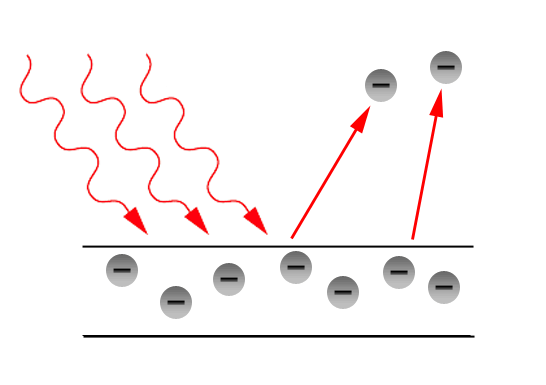 |
| A very simple model of the photoelectric effect |
Subscribe to:
Posts (Atom)